
Cumbria In Verse - Lakes To Fells In Poetry: A Journey Through Landscape and Language

Updated: Jul 31
There is a peculiar weight to a landscape that refuses to be merely seen. Cumbria, with its ancient fells and brooding lakes, holds such a weight. It is a place that insists on being felt, walked, breathed, and, in my current work, written. For the past months, my focus has been entirely consumed by the slow, often arduous, process of shaping this particular corner of England into language, for a collection I'm calling 'Cumbria In Verse – Lakes To Fells In Poetry', due for publication in March 2026.
This isn't a swift task, nor is it one that permits shortcuts. It is a commitment, a deep dive into the strata of place, memory, and the very act of seeing. The aim is not simply to describe, but to evoke; to find the precise verbal equivalent of a rain-swept tarn or the persistent wind over a high ridge.
The Heart of Cumbria: Beyond the Postcard View
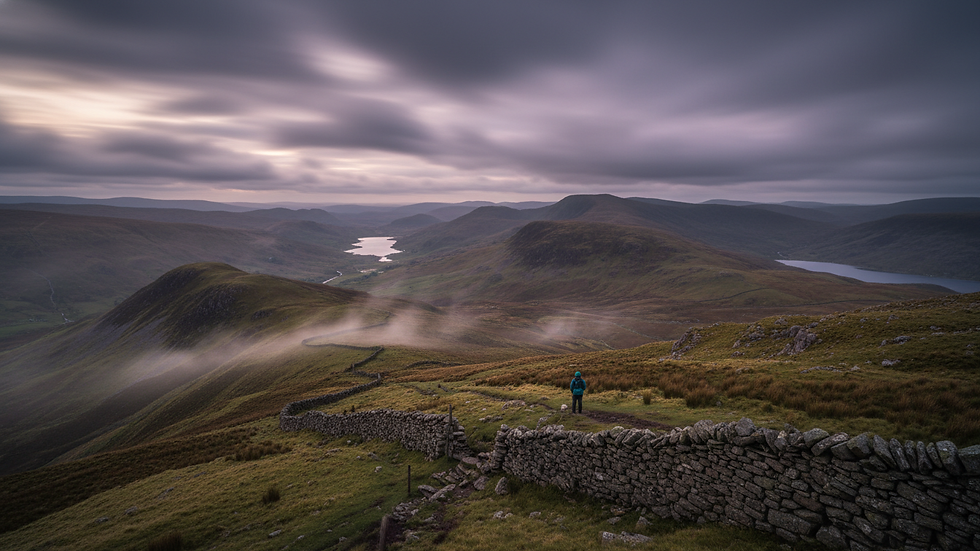
The immediate beauty of the Lake District is undeniable, almost overwhelming. Yet, to write truly of it, one must move beyond the picturesque. The challenge lies in excavating the less obvious truths, the textures beneath the surface gloss. It means attending to the subtle shifts in light on a scree slope, the particular scent of damp bracken after a shower, the sound of a distant sheep call carried on the wind, or the profound silence that settles over a valley at dusk.
These are not details one gathers in a single visit, nor are they easily translated into words. They require repeated immersion, a patient dwelling within the landscape until its rhythms begin to resonate within the language itself. The risk, always, is to fall into cliché, to repeat what has already been said. My task is to find a fresh angle, an unpredicted turn of phrase that reveals the familiar anew.
The Slow Unfolding of Place
To write place-based poetry is, in many ways, an act of prolonged observation. It is about allowing a place to unfold itself slowly, over seasons and years. It’s about revisiting the same paths, noticing how the light changes, how the water levels rise and fall, how the human imprint shifts and fades. This project, 'Cumbria In Verse - Lakes To Fells In Poetry', is a testament to that slow unfolding.
It involves not just walking the land, but reading its history, its geology, its folklore. To understand the fells, one must understand the forces that shaped them, the lives lived within their valleys, the stories etched into their stones. This research isn't academic in the dry sense; it's an intimate conversation with the past, a way of deepening the present encounter. Each poem becomes a small excavation, revealing layers of time and meaning.
The initial drafts are often clumsy, burdened by too much information or too little genuine feeling. The work then becomes one of distillation, paring away the inessential, searching for the distilled essence that allows the landscape to breathe on the page. It's a process of trial and error, of discarding more than is kept, until the words feel as inevitable and natural as the landscape they seek to capture.
Language as a Vessel
The most persistent struggle is with language itself. How to make words carry the weight of a mountain, the expanse of a lake, the swift movement of a stream? English, for all its richness, can feel inadequate in the face of such grandeur. The precision required is immense. A single misplaced adjective can flatten an entire vista; an imprecise rhythm can break the spell.
My aim is for the language to be transparent, to allow the reader to see through the words to the place itself. This means attending to cadence, to the sonic qualities of the lines, to the spaces between words as much as the words themselves. It's a constant negotiation between the literal and the lyrical, the concrete and the abstract. Each poem is an attempt to build a vessel capable of holding a small piece of Cumbria's vastness.
There's a quiet tension in this work: the desire to capture something fleeting, yet to give it permanence; to be true to the physical reality, while also reaching for its emotional resonance. It’s a solitary pursuit, often punctuated by moments of intense frustration, followed by brief, exhilarating flashes of clarity when a line finally settles into place, feeling right, feeling true.
The Unfinished Map
'Cumbria In Verse - Lakes To Fells In Poetry' is, as yet, an unfinished map. Each poem added is another contour line, another shaded valley, another peak marked. It is a project that demands patience, resilience, and a deep, abiding respect for its subject. The journey towards publication in 2026 feels both distant and intimately close, each word a step along the way.
The quiet dedication to this work, the hours spent walking, observing, drafting, revising, are the unseen architecture of the book. It is in these moments, wrestling with a stubborn stanza or searching for the exact rhythm of a Cumbrian lane, that the book truly takes shape, long before it reaches the printer's press. The landscape itself remains, indifferent to my efforts, yet it is this indifference that keeps the work honest. It demands a humility from the poet, a recognition that the place will always be larger than any language can fully contain. It simply is, and my words are merely an echo, a gesture towards its enduring presence.
The Emotional Landscape of Poetry
Writing poetry is not just about the physical landscape; it is also about the emotional landscape. Each poem I craft is infused with my own experiences, thoughts, and feelings. The act of writing becomes a way to process my connection to the land. I find that the more I immerse myself in the natural world, the deeper my understanding of my own emotions becomes.
As I wander through the fells and valleys, I often reflect on my own journey. The rugged terrain mirrors the challenges I face in life. Just as the landscape has its ups and downs, so too do our personal stories. I strive to capture this interplay between the external world and my internal landscape in my poetry.
The Influence of Nature on Creativity
Nature has a profound influence on creativity. The sights, sounds, and scents of the outdoors awaken my senses and inspire my writing. The rustling of leaves, the call of a bird, or the gentle lapping of water against the shore can spark a line of poetry or a vivid image.
I believe that spending time in nature is essential for any creative person. It allows us to recharge and reconnect with our thoughts. The beauty of the landscape serves as a backdrop for our imagination to flourish. In my poetry, I aim to convey this sense of wonder and inspiration that nature provides.
The Journey of Self-Discovery
Writing poetry is also a journey of self-discovery. With each poem, I delve deeper into my thoughts and feelings. I explore my memories, my dreams, and my fears. The process can be both enlightening and challenging. It requires vulnerability and honesty.
As I write about the landscapes of Cumbria, I find myself reflecting on my own life experiences. The poems become a mirror, reflecting my innermost thoughts and emotions. This journey of self-discovery is not always easy, but it is essential for growth as a poet and as a person.
Sharing My Poetry with the World
As I work on 'Cumbria In Verse - Lakes To Fells In Poetry', I am excited to share my poetry with others. I hope to connect with readers who appreciate the beauty of regional poetry. My aim is to evoke emotions and create a sense of place through my words.
I invite you to join me on this journey. If you resonate with the themes of nature, self-discovery, and the emotional landscape of poetry, I encourage you to explore my work. You can find my poetry book, Cornwall In Verse - Tide To Tor In Poetry, available on Amazon.
In conclusion, the act of writing poetry is a deeply personal and transformative experience. It allows me to explore the landscapes of both the external world and my inner self. I hope that my words will resonate with you, inviting you to reflect on your own journey and connection to the landscapes around you.


Comments